
A serious incident involving artificial intelligence and the U.S. military is raising new questions about how AI should be used in national security.
According to a CNN report published on September 18, an AI-assisted intelligence assessment incorrectly identified cargo aboard a Chinese commercial vessel as being connected to a nuclear weapons program.
The information was serious enough that the U.S. military reportedly began preparing to intercept the ship.
Armed personnel were preparing for a possible boarding operation, and military aircraft were already in the air.
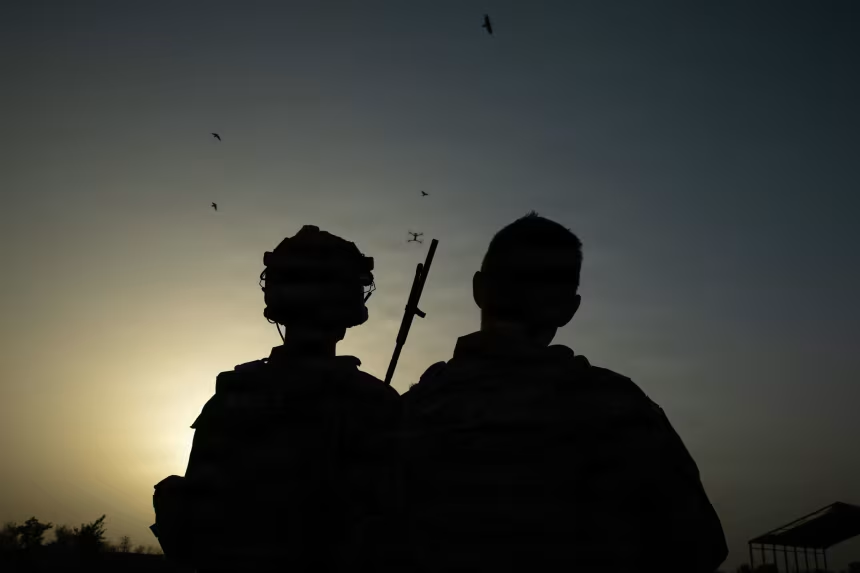
Spc. Alva Gonzalez/US Army
But before the operation was carried out, officials reviewed the intelligence more closely.
They discovered that the information was wrong.
The operation was stopped.
So what exactly happened, and how did artificial intelligence become involved?
The incident reportedly began with an intelligence analyst working for U.S. Special Operations Command Pacific.
The analyst was investigating a Chinese vessel and trying to determine what it was carrying.
According to CNN, the analyst used an AI chatbot as part of the intelligence analysis.
The system reportedly processed information that included open-source intelligence as well as classified signals intelligence.
The AI then produced an alarming conclusion.
It suggested that cargo aboard the Chinese ship included material connected to a nuclear weapons program.
That information was significant because intelligence involving nuclear-related material can immediately become a national security concern.
But the AI-generated conclusion was not correct.
The problem became more serious when the information moved beyond the chatbot.
According to the reporting, AI was also used to help transform the analysis into a formal military intelligence report.
That report then entered the military intelligence system.
This is an important part of the story.
There is a major difference between asking an AI chatbot a question and having information produced with AI appear inside an official intelligence report.
Once the information entered that system, other people could use it when making operational decisions.
And that’s apparently what began to happen.
Based on the intelligence, the U.S. military started preparing an operation involving the Chinese vessel.
CNN reported that armed personnel were preparing to board the ship.
Military aircraft were also reportedly already airborne.
However, before the interception took place, officials examined the intelligence behind the operation more carefully.
The assessment did not hold up.
CNN reported that a person familiar with the incident characterized the intelligence as entirely false.
The military then stopped the operation.
CNN said it could not independently determine exactly what cargo the Chinese vessel was actually carrying.
That detail is important because it means we should not speculate about what was really on the ship.
What is clear from the reporting is that the intelligence assessment connecting the cargo to a nuclear weapons program was found to be incorrect.
And that is where this story becomes much bigger than one Chinese ship.
The U.S. military, like many other government organizations, is increasingly interested in using artificial intelligence to process information.
There are understandable reasons for that.
Modern intelligence agencies deal with enormous amounts of data.
Analysts may need to examine satellite information, communications, documents, databases, images, public information and many other sources.
AI systems can potentially help humans search and analyze this information much faster.
A task that might take a person hours could potentially be completed by AI in minutes.
But there is a major problem.
Large language models can generate false information.
This is commonly called an AI hallucination.
An AI model can produce an answer that sounds detailed, confident and completely believable while still being wrong.
We’ve already seen this problem with consumer AI systems.
Chatbots sometimes invent sources, produce incorrect facts or misunderstand information.
Usually, the consequence is a bad answer on a computer screen.
But using similar technology inside military intelligence creates a completely different level of risk.
If incorrect information enters a military report, that information could potentially influence real operations.
And in this case, the operation reportedly involved a Chinese vessel.
That makes the situation particularly sensitive because the United States and China are two major military powers.
An interception or boarding involving a Chinese ship could potentially create a serious diplomatic or military incident, depending on the circumstances.
The fact that the operation was stopped before the reported interception is therefore an important part of what happened.
Human review ultimately caught the problem.
But the incident also raises questions about why the incorrect intelligence was able to progress as far as it reportedly did.
The central issue isn’t simply whether AI should be used by the military.
AI can potentially be extremely useful for intelligence analysis.
The bigger issue is how its output is verified.
If an AI model identifies something important, analysts need to understand where that conclusion came from.
They need to check the original evidence.
And when the information could lead to a military operation, the verification process becomes even more important.
This also creates a problem known as automation bias.
That’s when humans begin trusting the output of an automated system because they assume the computer has already analyzed the information correctly.
AI can make this problem more difficult because modern models are very good at producing convincing explanations.
The answer can look professional.
It can sound intelligent.
It can contain technical details.
But none of those things guarantee that the conclusion is true.
That’s why this incident is important for the wider AI industry.
We are entering a period where artificial intelligence is moving beyond simple chatbots.
AI is increasingly being used to help write software, analyze financial information, detect cyber threats, conduct scientific research and support government operations.
Military organizations are also exploring how AI can be used for intelligence, logistics, surveillance and decision support.
That means AI mistakes can increasingly have consequences outside the computer.
And the higher the stakes, the more important verification becomes.
The U.S. military did ultimately stop this operation after the intelligence was reviewed.
But according to CNN’s reporting, preparations had already progressed far enough that armed personnel were preparing to board the vessel and aircraft were in the air.
That’s what makes this case significant.
It provides a real example of the challenge governments face as they introduce generative AI into sensitive environments.
AI can process enormous amounts of information very quickly.
But speed and intelligence are not the same thing as reliability.
And when AI is being used in national security, an incorrect answer isn’t simply an embarrassing chatbot mistake.
It can become part of a real-world decision.
The lesson from this incident is therefore not that governments should simply stop using artificial intelligence.
It’s that AI-generated intelligence needs strong human oversight, clear verification procedures and safeguards before it can influence serious operational decisions.
Because as AI becomes more deeply integrated into governments and militaries around the world, the question is no longer only about what these systems are capable of doing.
It’s also about what happens when they’re confidently wrong.
Sources : US military had close call after using AI for false intelligence report, source