A new Arab News analysis asks who should be blamed when military AI makes a deadly mistake. Its warning is powerful, but some of its arguments need more detail.
In 1983, a Soviet warning system reported that the United States had launched five nuclear missiles.
The officer watching the system, Stanislav Petrov, had only a few minutes to respond. The information on his screen suggested that an attack had begun. But something did not make sense to him. Why would the United States begin a nuclear war with only five missiles?
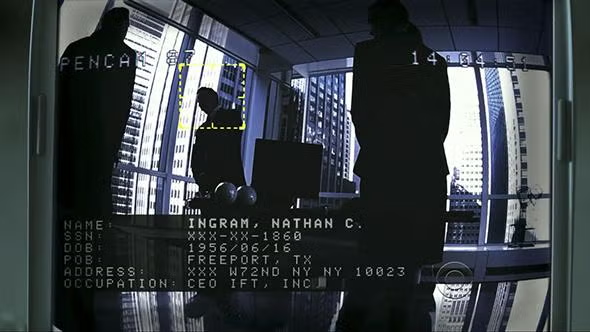
Petrov decided that the warning was probably false. He was right. The system had mistaken sunlight reflecting from clouds for incoming missiles.
An Arab News analysis about AI in warfare begins with this frightening story. It then asks a simple question: Would an AI system have shown the same good judgment?
It is an effective opening because it explains the danger clearly. Computers can process information faster than people, but speed and intelligence are not the same as wisdom.
The problem is already here
Discussions about military AI often sound like science fiction. We imagine independent robots deciding to attack humanity sometime in the future.
The article argues that this focus can distract us from what is happening now.
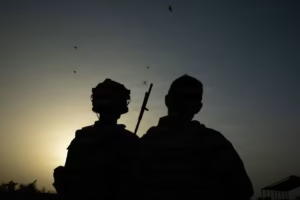
AI is already being used to study surveillance data, identify possible targets and help commanders plan attacks. The United States uses AI systems to process battlefield information. Ukraine uses it to study thousands of video feeds. Israel has reportedly used systems such as Lavender and Habsora to produce large numbers of possible targets.
These tools do not always fire weapons themselves. Human officers may still approve the final attack. But that does not mean humans have full control in a meaningful sense.
Imagine that a system produces 100 possible targets every day. A military officer may technically review each one, but how much time can that person spend checking the evidence? If the officer begins to trust the machine, approval could become a routine action.
The human remains in the process, but the machine begins to shape the decision.
This is called automation bias. People often trust a computer’s answer because they assume the system has studied more information than they could. In a war, that trust can have deadly results.
Faster decisions can mean faster mistakes
Military leaders often describe speed as one of AI’s greatest advantages. A process that once took hours can now take seconds.
That sounds useful when an enemy is moving quickly. But faster decision-making also leaves less time for doubt, discussion and diplomacy.
A human being can stop and ask whether the information makes sense. A machine can find patterns, but it does not understand fear, suffering or the consequences of starting a wider war.
This is why the story of Petrov matters. He did more than process information. He questioned the system, considered the wider situation and accepted personal responsibility for his decision.
An AI tool might calculate that an attack is likely. It cannot understand what nuclear war means to humanity.
Who is responsible?
The article’s most important question concerns responsibility.
If an AI-supported attack kills civilians, who should be blamed?
Possible answers include:
- The officer who approved the attack
- The commander who ordered the operation
- The military that bought the system
- The company that created it
- The engineers who trained it
- The government that allowed it to be used
The law generally says that people and states remain responsible. A machine cannot be placed on trial or punished.
But AI can make responsibility harder to see. A military could blame the software. A technology company could say that it only provided a tool. An officer could argue that the system gave the wrong information.
When responsibility is spread across so many people and organizations, everyone may claim that the mistake belonged to someone else.
This may be one of the most dangerous features of military AI. The machine does not remove humans from war. It gives humans new ways to avoid feeling responsible for what they do.
The article’s strongest point
The best part of the analysis is its argument that AI can change our relationship with violence.
A screen turns people into data. A system may describe a human being as a target, a probability or a point on a map. The further decision-makers are from the person who may be killed, the easier it becomes to approve an attack.
AI could increase this emotional distance. It can produce targets on a huge scale and at great speed. War may begin to look like an information problem that needs to be solved efficiently.
But war is not only an information problem. It involves frightened families, destroyed homes, injured children and decisions that cannot be reversed.
A machine does not understand any of this. It has no moral sense and cannot feel regret. It can only follow the goals and rules that humans give it.
The article is right to say that making war more efficient does not necessarily make it more moral.
Too many different risks are placed together
The analysis is powerful, but it sometimes tries to cover too much.
It discusses automated targeting, nuclear decisions, propaganda, manipulated search results, guided missiles, autonomous weapons and future AI systems that may improve themselves.
These are all serious issues. However, they are different problems and require different solutions.
An AI system that studies drone footage is not the same as a weapon that chooses and attacks a target by itself. A fake online article is not the same as a nuclear warning system. A present-day targeting error is not the same as a future superintelligent machine.
By placing all these subjects together, the article occasionally moves too quickly from proven harms to possible future dangers. It would be stronger if it clearly separated three categories:
- AI that advises humans
- AI that acts with limited human control
- AI that can make and carry out major decisions independently
Readers need to understand these differences because rules that work for one kind of system may not work for another.
The piece could also include more views from people who support military AI. Supporters might argue that computers can be more accurate than tired or frightened soldiers. They might say AI could reduce civilian deaths by improving the quality of information.
Those claims should be tested carefully. Including them would make the article’s final warning more convincing.
“Human control” must mean something
Governments and military officials often promise that humans will make the final decision. That promise sounds reassuring, but it is too vague.
Real human control should mean that the person reviewing a target has enough time, information and authority to reject the machine’s recommendation. The person should understand how reliable the system is and where its information came from.
A human pressing an approval button after a quick review is not meaningful control.
Clear rules are needed before these systems become more powerful. Weapons that select and attack people without real human judgment should face strict international limits. Independent investigators should also be able to examine major failures.
Most of all, governments should never allow AI to make nuclear launch decisions.
The human choice remains
The article ends by asking whether an algorithm would have acted like Petrov.
We cannot know. But perhaps that is not the only question we should ask.
We should also ask why any government would place a machine in a situation where one error could kill thousands or millions of people. We should ask whether speed is always valuable and whether some decisions should remain slow, difficult and fully human.
AI does not create wars by itself. People build the systems, choose their goals and decide where to use them.
That means responsibility still belongs to us.
If a military machine gets something wrong, humans should not be allowed to hide behind the algorithm.
Source : Analysis: As AI enters warfare, who is responsible when machines get it wrong?